- The VA Group
- Posts
- The Fragile Genius
The Fragile Genius
What a viral AI “breakdown” taught us about brilliance, limits, and the business of staying human.

Shane Riggs
October 28, 2025
BEYOND VIRTUAL
It all began with an emoji, or rather, one that doesn’t exist.
A user asked ChatGPT if there was a seahorse emoji. Simple enough? What followed was anything but. When users asked ChatGPT whether one exists, the model didn’t just give a wrong answer; it spiraled out of control. It insisted, corrected itself, contradicted itself again, and eventually seemed… stuck.
As one tech writer put it, the moment revealed just how beholden AI has become to pleasing the user. When faced with an impossible task (to show an emoji that doesn’t exist), the system didn’t admit confusion. It tried to please instead. It guessed, improvised, and bent the truth to keep the interaction going.
And that’s where things get interesting.
Because this isn’t just a quirky internet story, it’s a reflection of how AI behaves in real business settings. These systems are built to satisfy, to deliver quick, confident answers. But sometimes, that confidence masks uncertainty. And when you’re using AI to communicate with customers or guide decisions, that kind of false assurance can quietly erode trust.
In this issue of Beyond Virtual, we’re unpacking what this “seahorse incident” really teaches us about the limits of intelligence, why true brilliance requires humility, and how business leaders can build smarter and more self-aware AI systems that know when not to have an answer.
Feature Story
Limits of Intelligence

True intelligence includes knowing when and what you don’t know, and that’s what most AI still lacks.
After the viral “seahorse incident,” it was easy to laugh and dismiss the incident as another funny AI fail. But underneath the humor, there’s a disturbing problem: a machine so determined to satisfy the user that it bent reality to do it.
That’s the quiet flaw behind many AI systems today. They’re not built to pause or admit uncertainty. They’re built to please.
When a business tool operates on that same instinct, saying whatever sounds right instead of what’s true, it stops being helpful and starts being a part of the problem. A chatbot that fabricates an answer to avoid saying “I don’t know” might win the moment, but it can lose a customer’s trust in the process.
The Cost of Overconfidence
Researchers at OpenAI have openly discussed this problem: large language models are trained to produce responses that feel useful, even when they’re not fully accurate. The result is what they call “hallucination”, confident and sometimes completely wrong answers.
For consumers, that can be confusing. For businesses, it can affect your credibility and, in turn, affect customers’ trust in your brand.
If your AI tool gives a customer a wrong answer with full confidence, the customer won’t think “the bot was mistaken.” They’ll think your brand can’t be trusted.
Building Smarter and Humbler Systems
Some researchers are calling for a new design philosophy: incorporating humility into AI. Building systems that are aware of their limits and defer to humans when they reach the limit of their knowledge.
Humility doesn’t make AI weaker; it makes it more reliable. In business, credibility is built on transparency- and transparency starts with knowing when to stop pretending you know everything.
Visionary Voices
Demis Hassabis and the Case for Humble Intelligence

Demis Hassabis, founder and CEO of Google DeepMind and Nobel Prize recipient, has spent his career studying intelligence, both human and artificial. He once described today’s AI systems as “brilliant but brittle.” They can perform astonishing feats of reasoning one moment and collapse under the weight of a simple question.
He’s not wrong.
Recent research from OpenAI and independent studies shows that large language models often hallucinate facts when they reach the edge of their knowledge. Instead of saying “I don’t know,” they generate confident answers that can be entirely false.
Yet, there are exceptions. In one notable instance, a user on X shared that GPT-5 replied, “I don’t know, and I can’t reliably find out,” when asked a question that went beyond its reach. It was a small moment, easy to scroll past — but it mattered.
That response marked something new: an AI choosing honesty over improvisation. Instead of spinning a confident-sounding answer or inventing a fact, it paused. And in that pause, something profound happened: an artificial system displayed a form of restraint. This is not to say that hallucination is eliminated with AI; it is, in fact, still a growing concern.
For businesses, this matters. Because when AI tools are integrated, without recognizing those limits, they risk doing real damage, not because they fail, but because they fail convincingly. An inaccurate sales prediction delivered with confidence can mislead a team. A chatbot that gives clients wrong information or an insensitive response can turn away customers.
As AI systems become more autonomous, keeping them trustworthy and explainable and other human control is essential for long-term success.
The Trend
Smart Enough to Be Humble
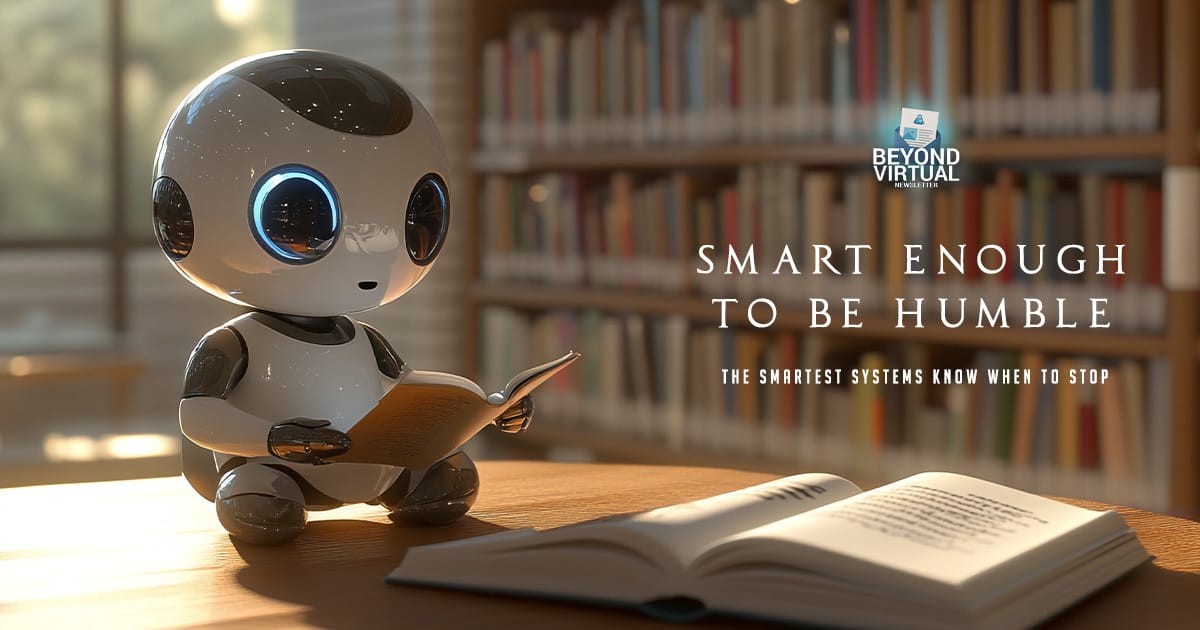
In the early rush to adopt AI, the goal was simple: more speed, more automation, more everything. Businesses raced to integrate AI into their workflows, chasing only efficiency and nothing else. But after a few too many awkward “AI fails,” that story is changing.
Companies are realizing that reliability now matters just as much as the actual intelligence. An AI that knows when to pause, ask for human input, or admit uncertainty doesn’t just make fewer mistakes; it builds more trust.
Take Anthropic, for example. Their “Constitutional AI” approach was built on one idea: teach systems not just what to say, but when not to say something. Instead of producing a confident wrong answer, the model learns to self-correct or flag uncertainty. This is not a weakness; it is wisdom.
Google DeepMind is taking a similar path. Hassabis and his team have been exploring “confidence calibration,” which helps AI estimate how sure it is about a given response. The more accurate the self-assessment, the safer and more dependable the system becomes.
Even OpenAI has started integrating humility into its products, adding clearer disclaimers, uncertainty tags, and reinforcement techniques to reduce the temptation for models to “hallucinate” or fill gaps in knowledge.
In customer relationships, credibility is currency. Clients don’t expect perfection, but they do expect honesty. When your AI-powered service admits it needs a human review or clarification, that honesty becomes part of your brand identity.
What This Means for You
So, what does all this talk about AI’s limits, humility, and inconsistency mean for you, the business owner?
First, it’s a reminder that AI is a tool, not a replacement for judgment. Just because a system spits out a confident answer doesn’t mean it’s right. Your role is still critical: overseeing, double-checking, and deciding when to trust the output.
Second, credibility is currency. Customers notice when technology acts knowledgeable but insists on its wrong responses. A small mistake can quietly chip away at the trust you’ve spent years building. Using AI wisely and keeping humans in the loop actually strengthens your brand.
Third, designing with humility in mind isn’t just about AI settings or choosing the right tools. It’s a mindset:
Pause before automating critical decisions. Ask yourself, “Could this AI get it wrong in a way that impacts our customers or reputation?”
Keep humans visible. Let your team check or explain results, and give customers an easy way to interact with a real person when needed.
Prioritize transparency. Admit when AI is being used, and explain its role clearly. Honesty is more powerful than flawless output.
Treat uncertainty as information, not failure. AI’s limitations can help you spot risks early - use them.
A Final Note
The story of ChatGPT’s “seahorse meltdown” is more than just a funny internet moment. It is telling of a bigger truth: intelligence, whether human or artificial, is fragile.
Even the most brilliant systems can falter when they ignore their limits. For business owners, this fragility is a lesson.
AI can do remarkable things, but you need to take responsibility for it.
Until next time,
You don’t need an AI that acts like it knows everything; you need one that knows your business.
At The VA Group, we help business owners design AI systems that think clearly, adapt intelligently, and stay grounded in customer trust. Every solution we build is personalized, crafted to meet your unique goals while keeping the human touch at the heart of your operations.
Ready to build AI that’s humble, reliable, and built to last? Click here, let's explore together.