- The VA Group
- Posts
- The AI Collaboration Crisis
The AI Collaboration Crisis
Why 95% of Business AI Investments Are Failing

Shane Riggs
December 03, 2025

BEYOND VIRTUAL
Here is the part that business leaders rarely say out loud. Most companies are not getting real value from the AI they are using.
MIT reports that more than 95% of AI investments fail to deliver meaningful financial returns. Not because the technology is weak, but because teams do not yet know how to work with it. Some people rely on it too heavily. Others refuse to trust it. Many give the AI the wrong level of context and end up redoing the work themselves.
If it was not obvious before, it is now. There’s a human-AI collaboration problem.
This edition breaks down why humans and AI still struggle to work well together and what leaders can do to close that gap.
Feature Story
Where Human and AI Collaboration Breaks Down

For all the progress AI has made, we still observe friction in the everyday moments where a person tries to work with it. This is the point where work slows down, and the quality of output is limited. At this point, users start to feel like AI is both a gift and a curse.
People Expect AI to Think Like Them
This is the root issue behind most disappointments.
Humans rely on intuition, tone, shared history, and context that do not need to be explained. AI does not operate that way. It follows patterns and instructions. When people expect it to “get it,” they feel let down. When they treat it like a literal system rather than a mind reader, the quality improves immediately.
Teams Give AI Too Much Context or Not Enough
The second point of failure is context.
Some teams copy entire threads, long briefs, or long texts into the AI and expect magic. Others provide a single vague request and hope it will fill in the blanks. Both approaches are problematic. AI performs best when given clear direction and focused information. Not everything and not nothing at the same time. Just that sweet spot where you give it what matters.
The Checking Problem
Inside every company right now, there are two kinds of AI users. One group trusts everything the model outputs, the other group resists and rewrites everything from scratch.
Both habits create their own problems. Overtrust leads to errors. Undertrust destroys any benefit the AI might provide and creates double the work. The challenge for leaders is getting teams into the middle.
Task Framing Is Still Weak
Most people believe the problem is the prompt. This may be true, but oftentimes, it is the task design.
When instructions are unclear, the AI produces unclear work. When the goal, constraints, and success criteria are defined, the AI can deliver strong first steps. Teams do not need to master prompt tricks. They need to learn how to brief the AI the same way they would brief a junior team member.
Visionary Voices
Google, Microsoft, and OpenAI Agree On One Thing
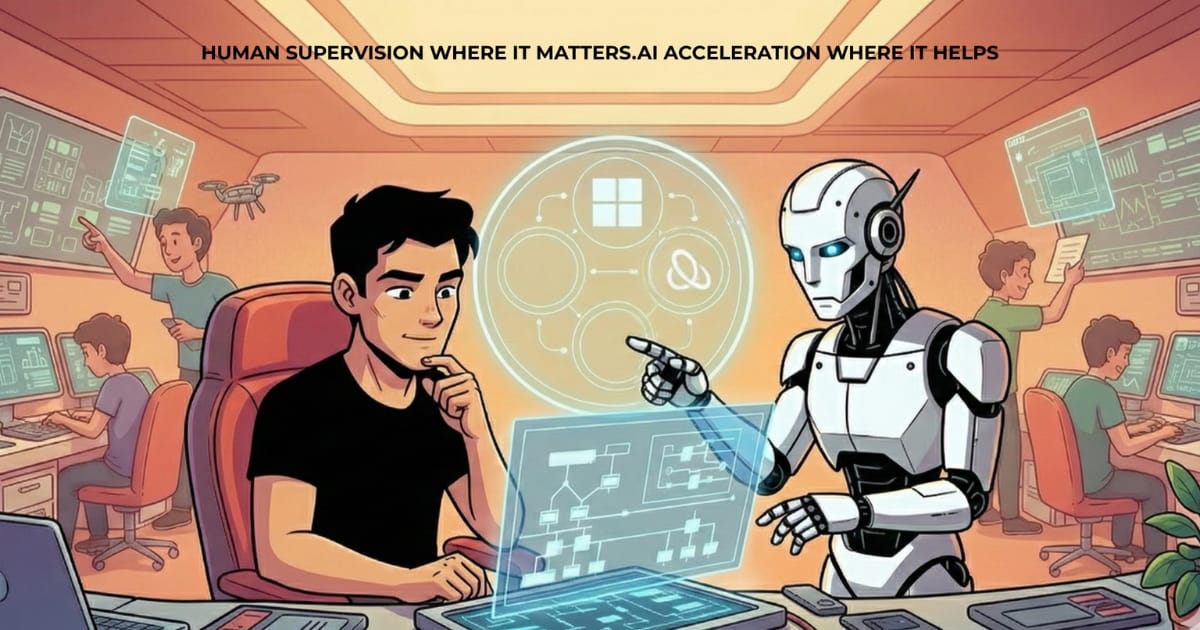
If there is one recurring theme among the people shaping the next generation of AI, it is this. The technology is moving fast, but it still needs humans to guide it. And the companies getting the best results are the ones treating AI as a partner, not a replacement.
Google has been especially public about this shift. When introducing the direction behind Gemini Agent, Sundar Pichai explained that Google has been investing in models that can understand more about the world, think multiple steps ahead, and take action with your supervision. It is the final part that matters. With your supervision. Even the most advanced agentic systems are being designed with the assumption that humans stay in the loop.
Microsoft has arrived at a similar conclusion. Their work on Copilot shows that teams perform better when they create guidelines for how AI should be used. Not highly technical rules, but the same kind of structure they would give a new employee. What the AI should handle, what it should send back for approval, what needs a second review, and what requires human judgment from the beginning. When the expectations are clear, the collaboration becomes smooth and predictable.
OpenAI’s research around tool use also reinforces this idea. Their models perform best when they are given structure, boundaries, and defined roles inside a workflow. The moment the AI knows the goal and the limits, the quality improves. The moment it is asked to figure everything out on its own, the output becomes inconsistent. In other words, the technology thrives when the collaboration is well designed.
Even outside the AI labs, leadership experts are paying attention. Harvard Business Review has noted that teams tend to lean on AI differently depending on stress levels, confidence, and time pressure. This creates uneven adoption across an organization. One department trusts it completely. Another refuses to use it. The result is a company running two different playbooks under the same roof.
What all these voices are pointing to is simple. The future will not be shaped by the companies with the most powerful models. It will be shaped by the companies that understand how to collaborate with those models. Clear roles. Clear expectations. Human supervision where it matters, AI acceleration where it helps.
These leaders are not focused on replacing people. They are focused on restructuring how people and AI work together in a way that feels natural and reliable.
The Trend
How Smart Companies Are Fixing the Collaboration Problem
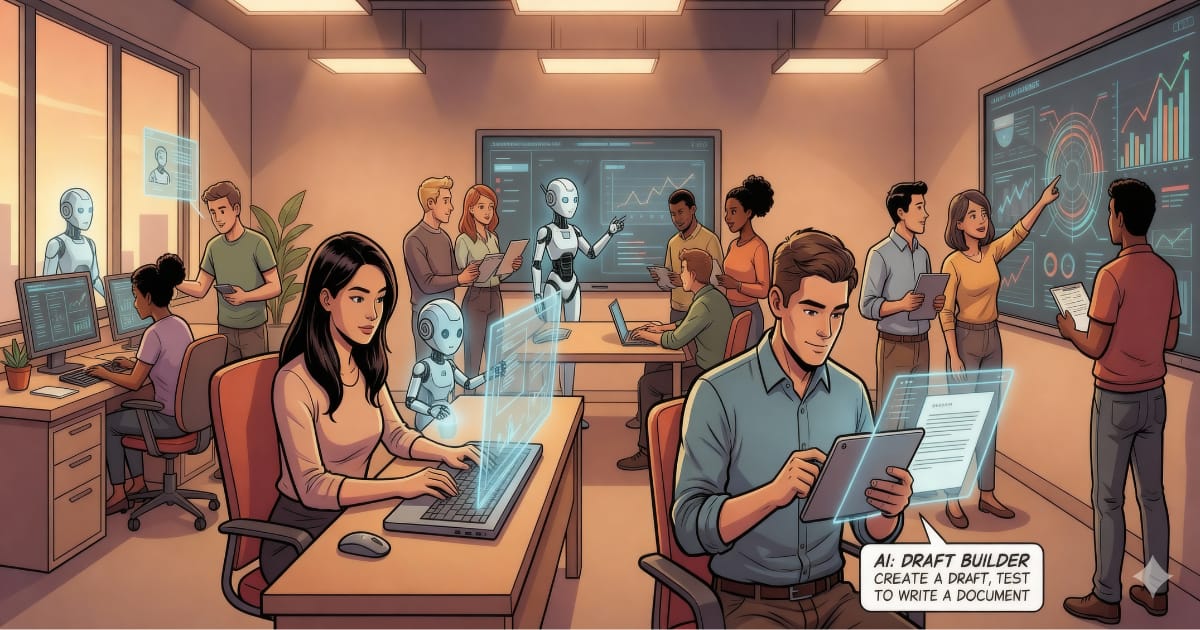
Across the companies seeing real returns from AI, there is a common theme. Progress is coming from small, thoughtful changes in how people work with the tools, not from sweeping automation projects. When the collaboration becomes clearer and more consistent, the results follow naturally.
Here is what these companies are doing differently and how you can apply the same methods inside your own business.
They give AI a job, not the whole job
Teams that get the most out of AI do not treat it like a general assistant. They give it a job title.
Editor. Research assistant. Draft builder. Pattern finder.
A defined role creates defined expectations. It also tells employees what the AI should not be doing. This prevents chaos and removes the fear of overreach.
Try this: Decide what role AI plays in your sales, support, marketing, and operations teams. Write it down. Share it. Let people collaborate with AI the same way they would collaborate with a colleague who has a specific job.
They have simple rules that everyone agrees on
The winning companies have short, uncomplicated policies for the use of the intelligence. This includes: checking key facts, providing sufficient context for the tool, and never blindly copying outputs.
These rules can help with consistency in the use of AI.
Try this: Create three simple rules for AI use inside your team. Put them at the top of every shared workspace or inside your SOPs.
They focus on the task, not the prompt
Prompt tricks create short-term wins. Task framing creates long-term capability.
The best companies teach their teams to define goals, constraints, success criteria, and the form the output should take. When people learn to brief well, the quality and reliability of AI outputs go up immediately.
Try this: When assigning any AI task, answer four questions.
What do I want?
What matters most?
What should be avoided?
What does success look like?
This can help reduce tension around human-AI collaboration.
They treat AI like a very fast junior teammate
This might be the mindset shift that makes the biggest difference.
AI is fast and tireless, but it also does not understand the full picture unless you give it the picture.
Companies that frame it this way keep humans exactly where judgment is needed, while letting the AI carry more of the repetitive load.
A Final Note
If there is one takeaway from this week’s edition, it is this. You do not need to overhaul your company to benefit from agentic AI. You just need to remove the friction that slows the collaboration. When the work becomes easier, you start stacking up your gains quickly.
If you decide to experiment with a new use case this week, begin with something small. A repetitive report? A long email thread? Let the AI take the first pass, and notice how much lighter the rest of the task becomes.
Until next time,
You've seen the reports: most AI investments fail because of the Human-AI Collaboration Problem. The good news? You don't need a tech overhaul! What you need is a clear framework for partnership.
Want to Unlock Real AI Value? Here’s HOW WE CAN HELP.
We’ve helped NUMEROUS Business Owners design the essential roles, rules, and task-framing strategies that remove collaboration friction and make AI consistent, reliable, and profitable.
Ready to move past trial-and-error and transform your AI investment into real returns?