- The VA Group
- Posts
- Everyone's Automating... What Are You Missing?
Everyone's Automating... What Are You Missing?
AI Agents: The Age of Self-Operating Workflows

Shane Riggs
November 18, 2025

BEYOND VIRTUAL
If you talk to enough business owners right now, you’ll hear a similar story: tasks that used to demand hands-on effort are starting to move forward with far less human involvement.
Not because systems are “thinking” on their own, but because today’s AI tools can put steps together, monitor, and keep processes moving once they’ve been set up. There is nothing mysterious about this; it's simply better upgrades to existing models.
What benefits do we gain from this relatively new technology?
A report gets drafted while you’re focused on something else, a customer email gets summarized, categorized, and routed before you open your inbox, and a research query comes back with organized sources instead of raw links. These were once considered futuristic possibilities, but they are already rolling out across mainstream platforms, from CRM suites to productivity software to industry-specific tools.
For years, automation handled repetitive steps, and augmentation helped humans move faster.
Now we’re entering a third phase where workflows don’t pause simply because a human isn’t watching every moment.
Not autonomous companies, not yet.
But clearly moving in that direction.
This edition explores the shift from mere AI assistant to more autonomous artificial intelligence, and why the momentum behind agentic AI systems designed to plan, execute, and manage multi-step tasks is pushing us toward a world where operational delays keep shrinking.
Feature Story
Agentic AI: The First Step Toward “Self-Running” Companies

“Agentic AI” gets tossed around a lot, but the idea behind it is surprisingly practical. It’s simply AI that can take a goal and move through the steps required to get there, not just completing one task, but carrying the work forward without waiting for constant instructions.
It’s the shift from “Tell me what to do next” to “Here’s the outcome, I’ll handle the path.”
This isn’t theoretical. It’s already showing up across the tools business owners use every day, quietly changing how work gets done.
Research Agents
Modern research agents don’t stop at giving you a summary. They search, filter, compare, and package information in a way that feels less like a search result and more like a first draft from a junior analyst.
Platforms like Perplexity, ChatGPT, Gemini, and others chst gpt are already operating in this direction.
Customer-Service Agents
Support tools such as Intercom and Zendesk now allow AI to carry an issue further along the resolution path. These agents can read context, check order details, draft replies, and move the conversation toward a solution before a human ever steps in, reducing repetitive work and speeding up response times.
Process Coordinators
Across productivity platforms, AI features are starting to act more like coordinators than assistants. Once you set the rules, they move tasks along: updating systems, notifying teams, generating drafts, and keeping workflows in motion without waiting in line for human input.
Put all these pieces together, and you notice a pattern.
AI isn’t just assisting anymore; it’s advancing the work on its own. A few years ago, that idea sounded far-fetched. Today, it’s built into the tools we open every morning.
Visionary Voices
How Adobe Quietly Became a Blueprint for Agentic AI
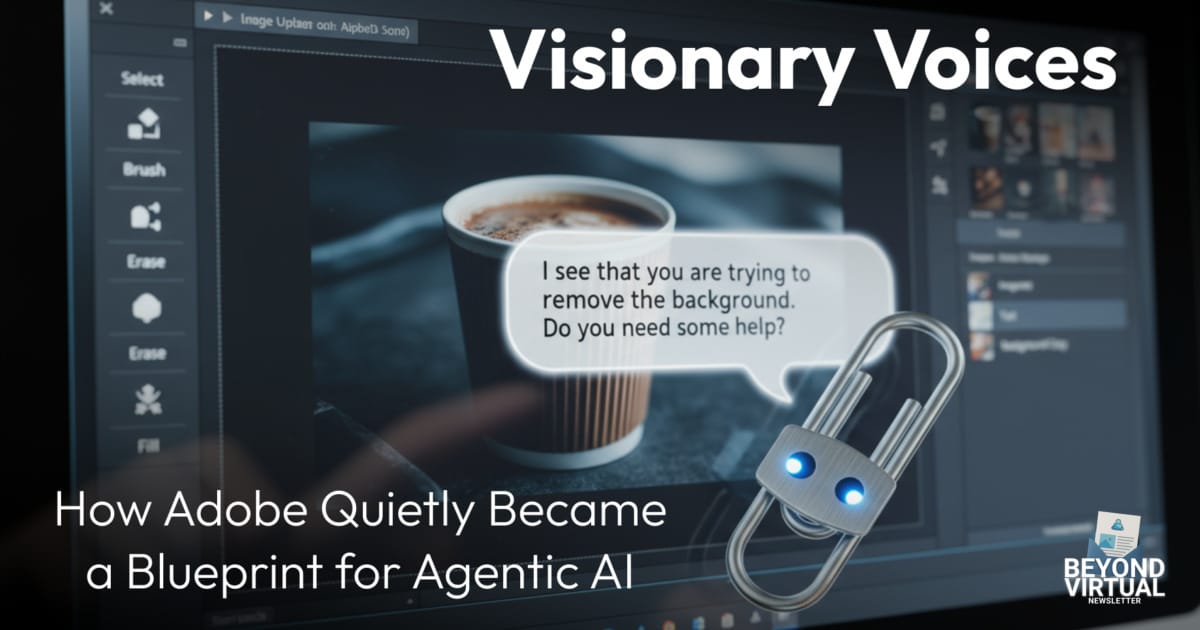
While many companies are still experimenting with simple AI assistants, Adobe has taken a more deliberate path: they’ve started giving their tools just enough agency to move work forward without making the user feel replaced.
"I firmly believe that marketing is, and will remain, people connecting with people, even as we continue to integrate AI into our workflows. For AI-powered marketing and creativity to generate real value, we must keep humans at the center of all we do."
Inside Adobe’s ecosystem, AI doesn’t sit around waiting for prompts. It notices what you’re doing, anticipates the next step, and offers options before you go looking for them. Features like automatic masking, background removal, content-aware adjustments, and design variations all point to the same idea: clearing the operational clutter so creators can stay focused on the actual concept.
And that’s the part most people overlook. Adobe didn’t introduce these tools to take over creativity. They introduced them to shorten the distance between the idea and the finished product, the part of the process that usually slows teams down.
As a result, we have faster experimentation, quicker revisions, and shorter turnaround times. All of these have a snowball effect on the overall efficiency of a company’s work.
Adobe’s approach is a reminder that agentic AI isn’t about systems that think for people.
It’s about systems that think with them, stepping in at the right moments and smoothing out the work that gets in the way of creating.
If early AI tools made creative teams faster, Adobe’s agentic direction is making the entire creative workflow feel lighter, smoother, and far easier to finish.
The Trend
Why Agentic AI Actually Matters, And What You Should Pay Attention To

Every few years, a new technology shows up that promises to “change everything.” Most don’t. Agentic AI might be one of the rare ones that actually shifts how companies operate, not because it’s flashy, but because it quietly removes the operational drag most businesses have simply learned to live with.
Talk to any founder or operator, and they’ll tell you the same thing:
The work doesn’t fail at the idea or even the execution; it mostly fails in the space between the steps.
What do we mean?
The follow-up that didn’t get sent.
The task that slowed to a standstill because one person was out.
The report that was “almost done” for three weeks.
This is where agentic systems suddenly matter. They keep things moving in those in-between moments that used to depend entirely on someone remembering.
But this shift only works if leaders treat agentic AI as an operational partner, not a magical engine that somehow “figures things out.” AI cannot think like humans do; it does not possess the power of free thinking, at least not in the way humans do, and there should be guardrails to guide its operations.
What Are Companies Doing Right
Here’s what the companies getting it right are doing differently, even if they don’t call it that:
They’re designing their workflows around outcomes instead of chores.
They’re giving their systems room to operate, but not enough room to wander.And most importantly, they’re keeping humans exactly where judgment is needed in the decisions, not the busywork leading up to the decisions.
That’s the part many people forget: autonomy isn’t the threat. Blind autonomy is.
When businesses hand over tasks without context, or when teams assume the system “knows what to do,” that’s when things go sideways, not dramatically, but in subtle ways that show up as the wrong customer response, the wrong escalation, or the wrong assumption. So how can we avoid this? Simple, consider AI a team member that needs supervision.
The sweet spot is getting AI to carry the pieces that slow everyone else down. So team members get the headspace to think and create at the level they’re actually paid for.
A Final Note
We’re now standing at the edge of a new kind of workflow, one where tasks don’t wait in inboxes, and progress doesn’t depend on who’s available.
The companies that give AI room to operate with guardrails, context, and human judgment in the right places will find their teams doing more of the work that actually matters.
Remember, Agentic AI won’t replace your people.
It will reshape the work around them.
P.S. If you have any thoughts and any tools you’d recommend, please feel free to share them with us and our community! We and the community will appreciate it very much.
Until next time,
Even with AI being readily available, setting it up is not an easy feat! Here’s HOW WE CAN HELP.
We’ve helped COUNTLESS BUSINESS OWNERS unlock growth by providing them with vetted and certified Virtual Assistants efficient with AI tools. Your breakthrough could be next!
Ready to automate your workflow? Click here and let's explore what's possible.